The information you provide to the chat will be recorded to improve your experience and to contact you. Please read our privacy notice to see how we are processing and protecting your data. Click to view our Cookie Notice.
We'd love your feedback—take a quick survey to help us improve.
How can we help you today?



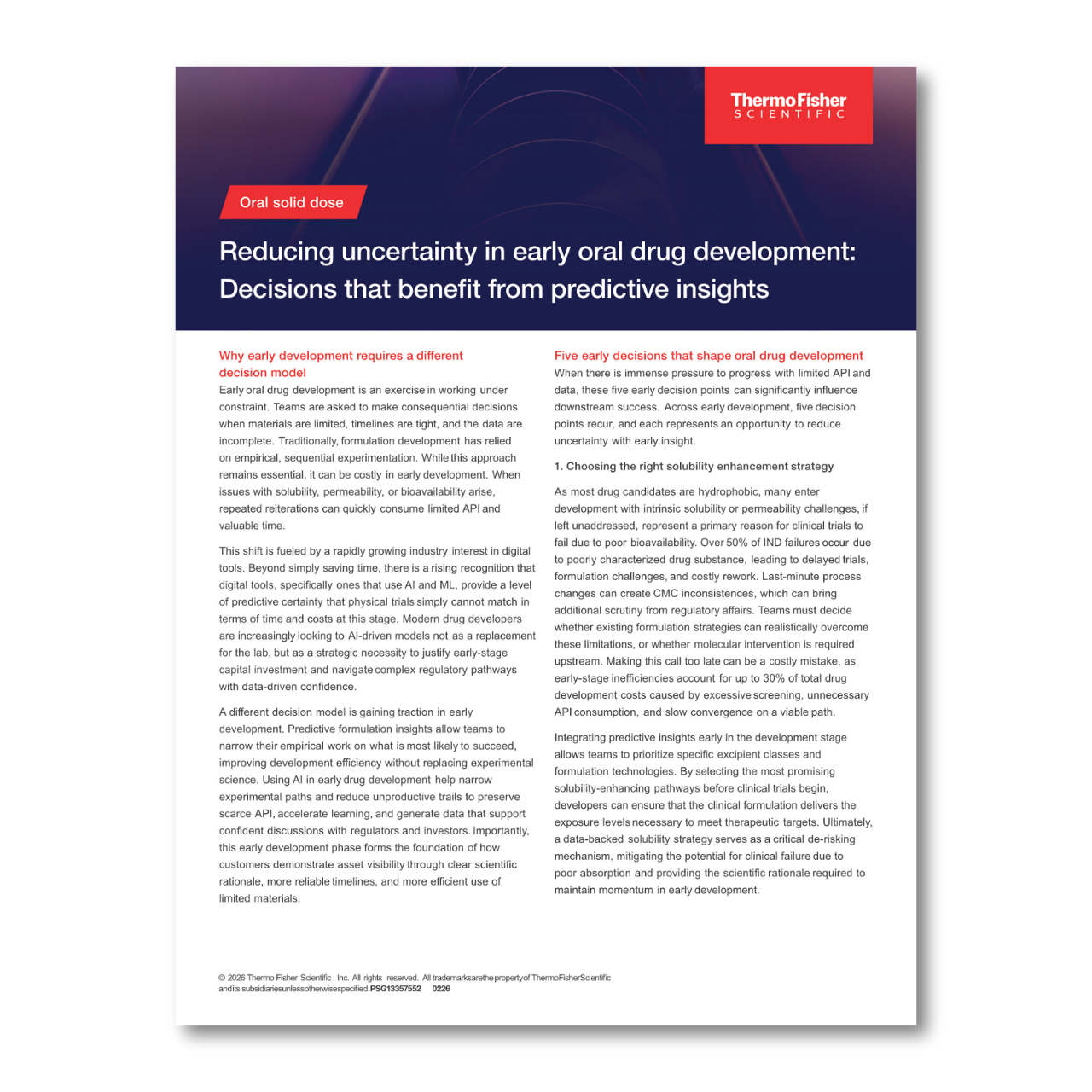
Reducing uncertainty in early oral drug development: Decisions that benefit from predictive insights
Navigate the complexities of early-stage development with data-driven confidence
Early oral drug development is often an exercise in working under extreme constraints, where teams must make consequential decisions with limited API, tight timelines, and incomplete data. While traditional empirical experimentation remains essential, relying solely on sequential trials based on trial and error can be costly and lead to repeated iterations that consume precious materials.
To overcome these challenges, modern drug developers are increasingly adopting a different decision model, one fueled by AI and ML. By integrating predictive formulation insights early, teams can narrow their empirical work to what is most likely to succeed, justifying capital investment and navigating regulatory pathways with increased scientific rigor.
This article explores five critical decision points in early development, where predictive insights can significantly reduce uncertainty and de-risk your program:
- Solubility enhancement strategy: Prioritize specific excipient classes and pathways to ensure clinical formulations meet therapeutic targets without excessive screening.
- FIH readiness: Project human dose and exposure estimates early to influence clinical planning and API demand before in vivo datasets exist.
- API–formulation compatibility: Identify manufacturability risks early to avoid committing scarce materials to approaches that are unlikely to scale.
- Treating stability as a design constraint: Use digital modeling to treat stability as an input rather than a late-stage validation step, reducing the risk of NDA delays.
- Scale-up and transfer feasibility: Utilize compaction simulation to model full-scale production using only a few grams of API, ensuring "right-first-time" validation batches.
What predictive insights look like in practice
The article also shows what predictive insights look like in practice. Thermo Fisher Scientific’s OSDPredict™ platform, a digital toolbox powered by AI/ML and proprietary Quadrant 2™ algorithms, supported 135 NDAs to be approved and solved over 400 solubility issues since 2011. Download the article to read case studies to see how predictive insights are used to accelerate early development.