


Supporting antibody drug conjugate trials through clinical logistics
How logistics pathways adapt to liquid and lyophilized ADC formulations.
By Pouria Motevalian, Director, Process Development, Pharma Services, Thermo Fisher Scientific
Industry Perspectives
Originally published in Contract Pharma on April 20, 2026.
Republished on Patheon.com with permission.
Antibody drug conjugates (ADCs) are advancing through clinical development with increasing complexity in both formulation and handling requirements. That complexity extends beyond development and into how clinical supply is managed across sites.
As a result, logistics execution becomes more sensitive to how shipments are planned, handled, and delivered. Small gaps in control can disrupt continuity across a study and introduce delays. Examples include temperature excursions in transit, storage conditions at site that don’t align with requirements, or shipments that arrive out of sync with dosing schedules.
This sensitivity reflects the nature of ADCs themselves. Because they combine biologic and cytotoxic components, acceptable handling conditions are tighter and less forgiving. That places greater pressure on how supply is managed from release through delivery to site.
The objective is consistent: Ensure each shipment arrives where it needs to be, under the right conditions, and at the right time. How that is achieved depends on the formulation.
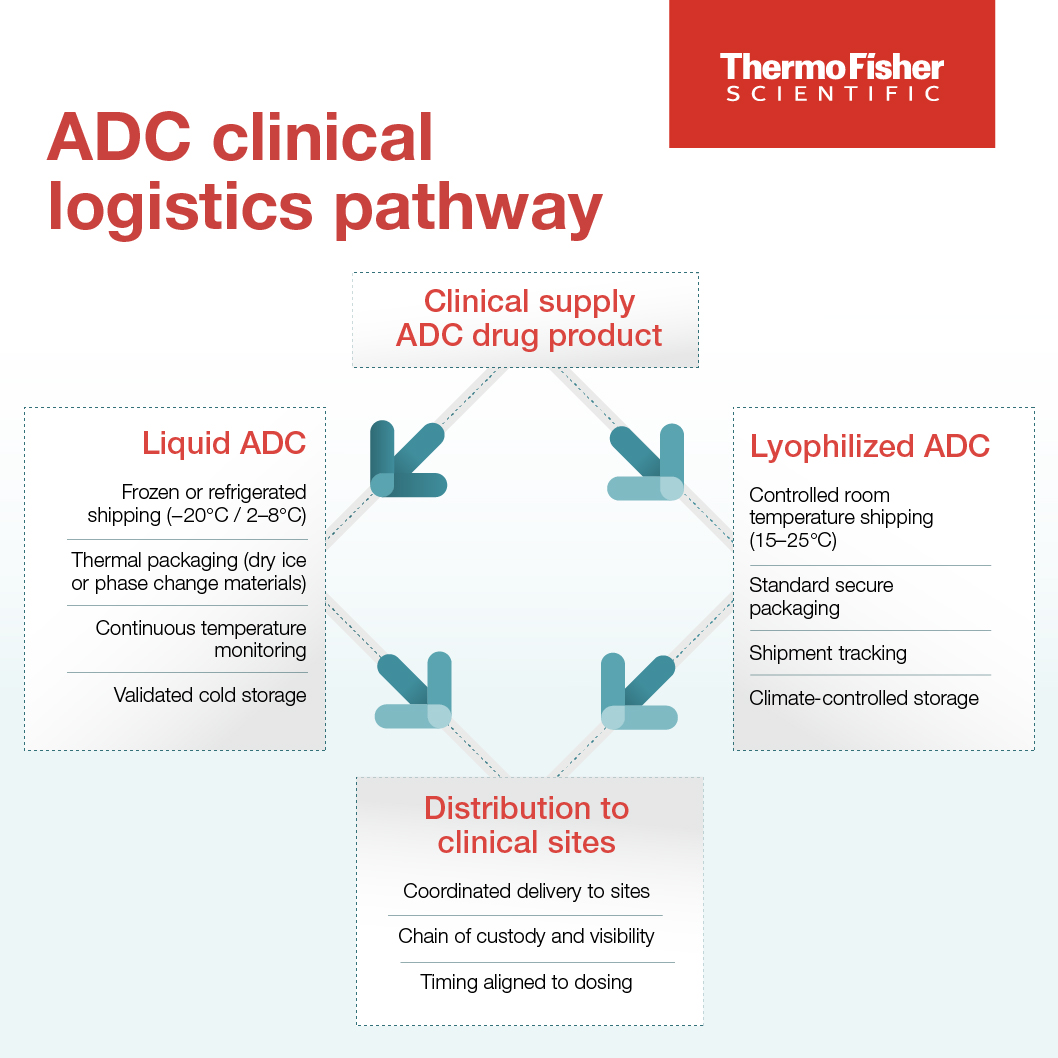
Where requirements diverge
The most immediate operational divide is between liquid and lyophilized ADCs, which require different approaches to shipping, storage, and monitoring.
For liquid ADCs, execution depends on maintaining a continuous cold chain. Shipments are managed at frozen or refrigerated temperatures using thermal packaging such as dry ice or phase change materials. Continuous temperature monitoring through data loggers and, in some cases, GPS-enabled tracking provides visibility throughout transit. Storage must be validated in advance, with shipments actively managed to prevent excursions that can compromise product integrity or delay dosing.
For lyophilized ADCs, the stability profile allows for controlled room temperature transport, reducing reliance on cold chain infrastructure. This shifts the focus from temperature control to consistency in handling and storage across sites. Packaging must still protect against environmental variability, and storage conditions must remain within defined limits to ensure consistency across sites.
These differences shape how supply strategies are built, how shipments are planned, and how risk is managed across the study.
Where pathways reconverge
Despite these distinct requirements, both pathways ultimately converge at the same point: reliable, compliant distribution to clinical sites.
At this stage, execution depends on:
- Coordinating delivery across a global network of sites
- Maintaining chain of custody and shipment visibility
- Aligning delivery timing with site readiness and dosing schedules
- Ensuring consistent handling at receipt and storage
Variability introduced earlier in the supply chain must be absorbed into a model that delivers predictability at the site level, where timing and condition directly determine whether dosing proceeds as planned.
Aligning execution to ADC requirements
Supporting ADC trials requires coordinating shipping conditions, packaging, monitoring, and storage so that supply holds together across the study, not just at individual points in the process.
When that coordination breaks down, the impact is rarely isolated. A temperature excursion, storage mismatch, or delayed shipment can surface downstream as missed dosing windows, site disruption, or resupply.
Maintaining control across these variables is what allows supply to move predictably from release through delivery to site, even as requirements vary across formulations and regions.
Read the original article on Contract Pharma.
Explore clinical supply chain solutions for complex biologics and ADC trials
Helpful resources