The information you provide to the chat will be recorded to improve your experience and to contact you. Please read our privacy notice to see how we are processing and protecting your data. Click to view our Cookie Notice.
We'd love your feedback—take a quick survey to help us improve.
How can we help you today?



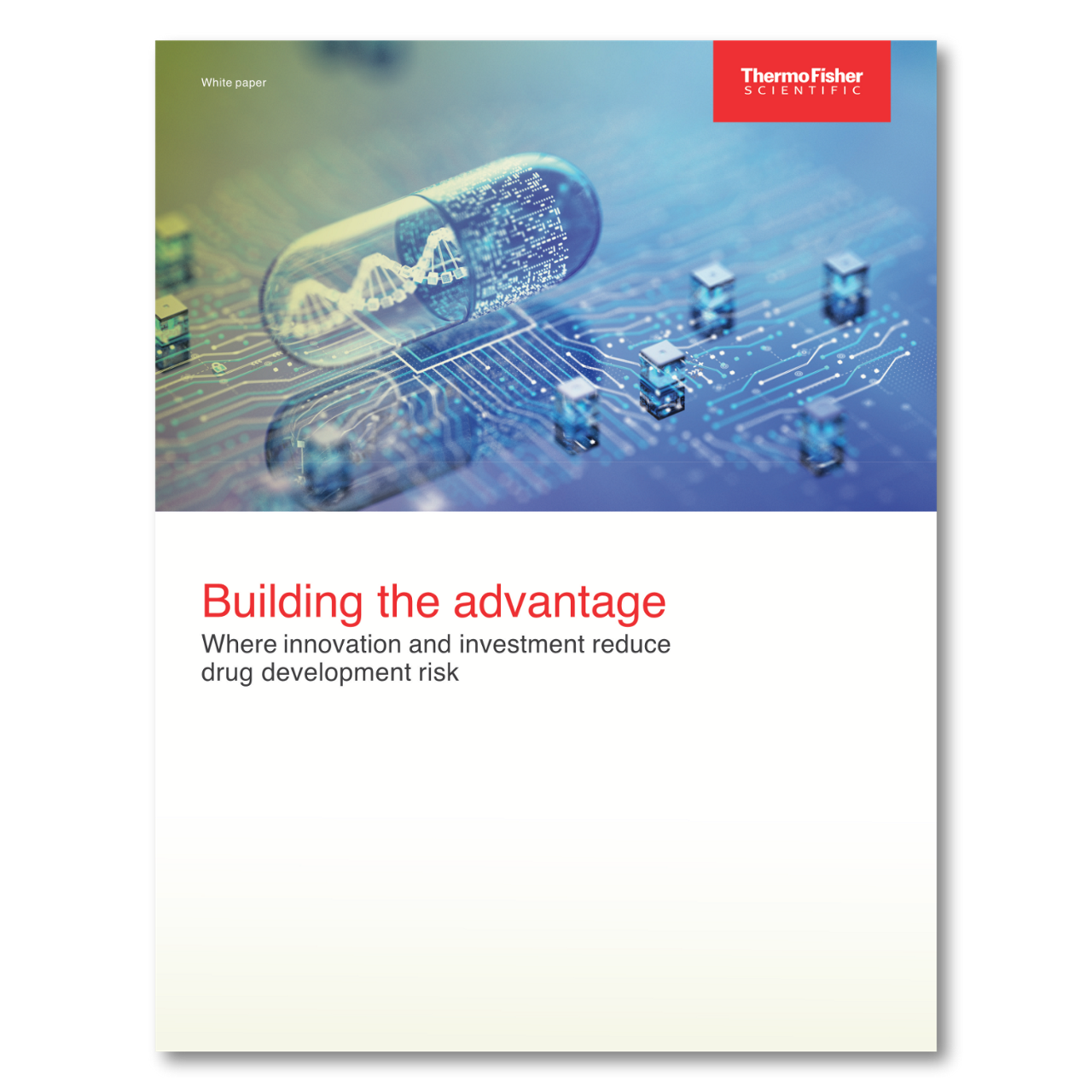
Building the advantage: Where innovation and investment reduce drug development risk
How targeted investment across development, manufacturing, and supply is transforming how drug development programs progress
Scientific complexity, compressed timelines, and global execution demands are reshaping how drug development programs are built and managed. As expectations shift, the margin for misalignment across phases, sites, and systems continues to narrow.
In this environment, risk does not appear at a single point. It accumulates throughout the lifecycle and is shaped by early technical decisions, infrastructure readiness, and the ability to maintain alignment as programs scale.
This white paper examines how Thermo Fisher Scientific Pharma Services applies innovation and investment to reduce lifecycle risk in development, manufacturing, and clinical supply.
Where innovation and investment reduce lifecycle risk
The paper focuses on four structural priorities, which together help reduce lifecycle risk and maintain execution stability as programs progress.
- Strengthening predictive insight and development continuity to reduce downstream adjustment and rework
- Building manufacturing environments that sustain performance under commercial throughput and regulatory scrutiny
- Expanding and balancing regional capacity to support continuity without introducing variability during transfer
- Integrating data and systems to improve coordination, transparency, and decision-making across sites and stages
As development programs expand across modalities and regions, innovation and investment decisions increasingly define how well execution holds as complexity increases.
Read the whitepaper to explore how these investment strategies are applied in practice and how they support program execution across development, manufacturing, and clinical supply.