


What is a CDMO? Seven things to look for in a quality partner
Author:
Thermo Fisher Scientific Content Team
Category | CDMO Services
Key takeaways
- A CDMO provides integrated drug development and manufacturing services
- CDMOs support programs from early formulation through commercialization
- Selecting the right CDMO partner requires evaluating seven critical attributes
- A structured evaluation framework can help reduce long-term program risk
From discovery to commercialization, drug development and manufacturing is a complex, years-long process that typically involves multiple rounds of research, testing, and regulatory approvals. While pharma and biotech companies can choose to venture out alone, they can also opt to have support on the journey from molecule to medicine to market.
CDMOs, or contract development and manufacturing organizations, are strategic outsourcing partners that pharma and biotech companies can work with to bring their products to patients. They help bridge internal resource gaps by offering specialized infrastructure, regulatory expertise, and scalable manufacturing capabilities across the drug lifecycle.

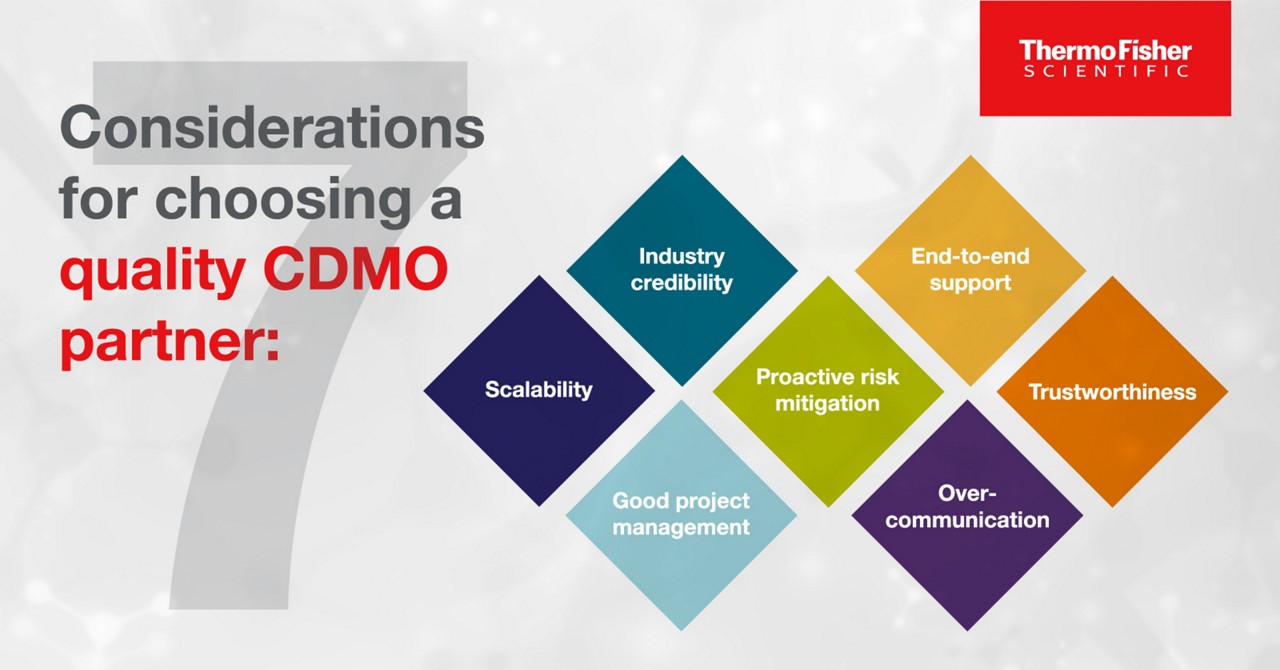
What should you look for when choosing a CDMO partner?
There are several considerations to take into account when picking the right CDMO company to partner with on the drug development and manufacturing journey, including:
- Industry credibility
- End-to-end support
- Proactive risk mitigation
- Overcommunication
- Good project management
- Scalability
- Trustworthiness
These critical attributes provide a structured evaluation framework that can help sponsors rank and review potential partners and make the right choice for their programs.
Exploring the critical attributes of quality CDMO partners
Industry credibility: Why is credibility important?
Why does industry credibility matter? A quality CDMO partner you can rely on will have a track record of success across all phases of drug development and manufacturing—demonstrating their ability to deliver consistent, compliant outcomes. Ask to see case studies and success stories upfront so you can feel fully confident in the choice you’re making. Also, be sure to ask preliminary questions, such as “what project management system does your team utilize?”, “how many small- and large-molecule drugs have you worked with?”, and “which therapeutic areas do you specialize in?” By establishing the CDMO’s industry credibility upfront, you can avoid potential roadblocks later on.
End-to-end support: What services does this include?
Many pharmaceutical and biotechnology companies want a one-stop shop that can handle a broad range of requests. An end-to-end CDMO needs to provide comprehensive capabilities that support the entire pharmaceutical development and manufacturing process. That includes drug substance and drug product development, analytical testing and stability studies, clinical trial material manufacturing, regulatory filing support, commercial-scale production, and packaging and supply chain coordination. By providing full-service support under one roof, the CDMO can reliably meet customer demands without them having to communicate and coordinate with multiple vendors. Being a true one-stop shop helps to streamline and simplify drug development and manufacturing across all phases.
“Risk mitigation isn’t a one-and-done activity. Rather, it’s an iterative process.”
Proactive risk mitigation: How should CDMOs handle risk?
According to the American Journal of Health-System Pharmacy, “as safety concerns about existing drugs continue and as more complex drugs and biologicals are introduced, the need to manage and mitigate risk while maintaining access to innovative therapies becomes increasingly important.”[1] Risk mitigation in drug development and manufacturing is vital to the pharmaceutical company’s overall success and reputation. Not only should a quality CDMO partner provide risk identification as the initial step, but they should also identify, evaluate, and prioritize risks as they evolve. Risk mitigation isn’t a one-and-done activity. Rather, it’s an iterative process that’s essential for bringing drugs to market—and maintaining regulatory alignment.
Overcommunication: Why is transparency essential?
Any relationship requires communication, and the relationship between a CDMO and a pharmaceutical company is no different. Communication—or really, overcommunication—is essential so both parties have a clear understanding of every project’s process. The pharmaceutical and biotechnology industry can change frequently when it comes to regulations, so it’s important to have a CDMO partner who stays on top of updates and can quickly switch plans accordingly. It’s also important to overcommunicate on project progress so everyone—including scientists, engineers, and partners—are on the same page. Transparency through overcommunication can help to resolve misunderstandings and overcome challenges, and it also allows for quick troubleshooting if anything goes awry.
Good project management: What role does this play?
On the heels of overcommunication comes good project management—truly the heart and soul of any ideal CDMO partnership. A CDMO’s project management expertise can make or break a drug’s development and manufacturing journey, and a project will only be as successful as the project manager who’s behind the scenes, helping to keep cross-functional projects moving smoothly. A good project manager should anticipate problems before they happen to avoid costly missteps, and they should always keep their partner in the loop with any plan changes. Project managers with solid communication skills who are quick and responsive to client needs help reduce delays and operational fragmentation.
“It’s one thing to manufacture 100 pills; it’s another to manufacture 100,000 or even 1,000,000.”
Scalability: How important is the ability to grow?
According to Deloitte, “as biotech companies attract fresh investment, they need to consider how they can scale up and what is required, in order to deliver on their promise of providing innovative medicines to patients.”[2] It’s one thing to manufacture 100 pills; it’s another to manufacture 100,000 or even 1,000,000. A high-quality CDMO partner needs to have the flexibility to scale production to meet the clinical and commercial needs of pharmaceutical companies across all phases of their development cycles. When evaluating a prospective CDMO partner, make sure they have the right infrastructure and equipment available to continually expand production while also maintaining quality, compliance, and supply chain continuity.
Trustworthiness: What makes a CDMO reliable?
Working with a CDMO is a major financial investment—as with all partnerships, trust is key. You need to trust the overall competence of the CDMO you choose. After all, their quality of performance can directly influence your drug’s journey from discovery to development and beyond. But trust can be difficult to quantify. What, exactly, makes a CDMO trustworthy? For one, they need to deliver on their promises to provide services and support to move your drug through the development journey. They also need to be transparent—especially in the face of any setbacks. Additionally, you need to trust that your intellectual property is safe in their hands, and that they share your vision of helping patients through medical innovations.
Identifying the right partner is a process
On average, it takes 10-15 years and costs $2.6 billion to develop a new drug.[3] That’s why it’s so essential that pharma and biotech sponsors partner with a CDMO they can trust, every step of the way. But identifying the right CDMO is a process—one that requires careful consideration.
Ready to find the right CDMO partner?
Although there are more than seven attributes to consider when selecting a CDMO company, trust—along with industry credibility, end-to-end support, proactive risk mitigation, overcommunication, good project management, and scalability—is an excellent place to start the evaluation process.
See how a fully integrated, end-to-end CDMO partner can help enhance the value of your drug development program: How the Accelerator™ Drug Development Model Enhances eNPV
Frequently asked questions (FAQs)
Contract development and manufacturing organizations (CDMOs) are strategic outsourcing partners that provide integrated services for pharma and biotech companies, helping to bridge internal resource gaps.
CDMOs can provide a broad range of services, including formulation development, analytical testing, clinical manufacturing, regulatory support, commercial production, and supply chain coordination.
Evaluate their ability to provide and prove their industry credibility, end-to-end support, proactive risk mitigation, overcommunication, good project management, scalability, and trustworthiness.
Sponsors choose to work with CDMOs to access their depth and breadth of development expertise and state-of-the-art infrastructure and manufacturing equipment that they don’t necessarily have in-house.
View references